Why Won’t My Sub-Zero Door Stay Closed?
Written by
Elena Sandoval
Refrigeration technician — cabinet, door and seal work · 24 years in the trade
Checks seal geometry and door closure first on a warm-cabinet call. A unit fighting a poor seal all day makes the sealed system read badly, and the readings only mean anything once the door is closing the way it was built to.
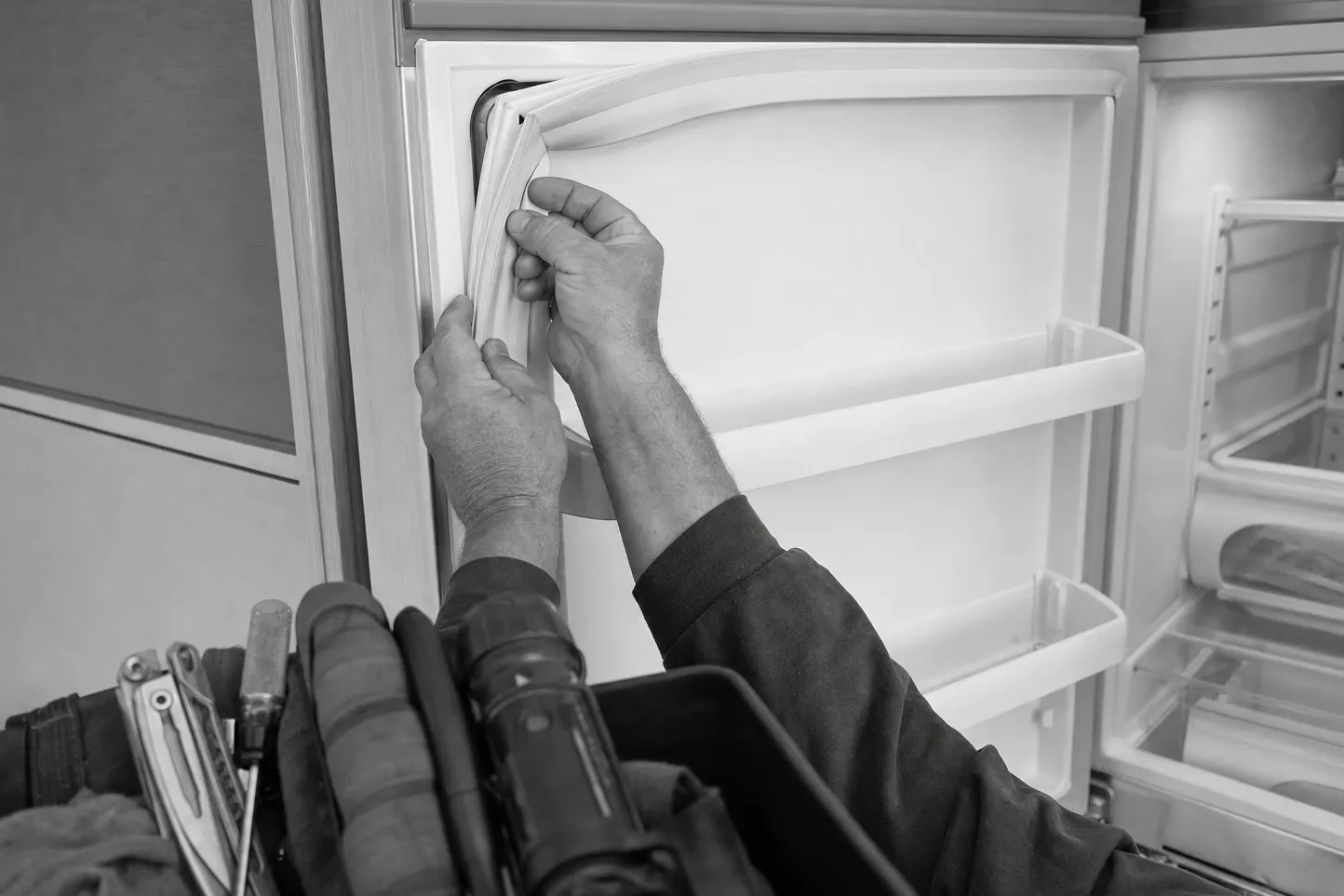
Doors are the only part of a built-in that a household operates by hand, several thousand times a year, and they are the first thing to tell you something has moved. The complaint arrives in one of three shapes: it will not catch at all, it catches and then eases open again over a minute, or it seems shut and the cabinet is quietly running twice as long as it used to.
What “will not stay closed” actually looks like
Stand square to the cabinet and watch the last two inches of travel. A door in good order slows, meets the frame all the way round at once, and pulls itself the final fraction without help. A door that has gone wrong does one of these instead.
It meets at one point first — usually the top corner on the handle side — and rocks very slightly before it settles. It closes and then opens again by a few millimetres as the air pressure inside equalises, which is a seal problem in disguise. Or it closes properly but the gap down one side of the door is wider at one end than the other, which is a weight problem wearing a seal problem’s clothes.
None of those three is worth guessing at, because each one has a different fix and two of them cost nothing but an afternoon of somebody’s attention.
The seal: what goes hard, and how you prove it
The moulding round the edge of the door is a flexible section with a magnetic strip running inside it. New, it is soft enough to squash flat against the frame and strong enough to hold the door there. As it ages the material stiffens, and a stiff seal does two things: it stops deforming to take up small irregularities, and it pushes the door away instead of drawing it in.
The test takes a minute and needs a strip of paper — a receipt is ideal. Put it across the frame, close the door on it, and pull it straight out. On a healthy seal it drags. Where it slides out freely, the seal is not touching, and that is the spot to report. Work round the whole door: top, both sides, along the bottom. A single soft corner is still a fault; that is where the room air gets in, and where the frost or the damp will start.
Two other things are worth noticing while you are there. A seal that has taken a set — a permanent flat or a wave in the section — will not come back with cleaning, though a wipe with warm water does remove the film that makes a seal grab unevenly. And a seal that has shrunk slightly leaves the corners looking stretched; those pull away first because a corner is the one place the moulding has to bend in two directions.
The hinge: weight, and what it has been carrying
Every hinge was set for the weight that was on the door the day the appliance was installed. On a panel-ready cabinet that weight is joinery, and joinery is the part of a kitchen most likely to change. A new front, a heavier species, an extra coat of finish, a handle swapped for something substantial — each adds load to a fixing that was adjusted for something lighter.
What that produces is a door sitting a fraction lower at the handle end than at the hinge end. Because the seal is only a few millimetres deep, a fraction is all it takes for the top corner to stop making contact while the bottom is still tight. The door meets the cabinet corner-first, rocks, and does not settle.
You can see it without tools. Stand back and look at the gap between the door and whatever is next to it, at the top and at the bottom. It should be the same. If it is visibly wider at the top, the door has dropped. If two doors sit side by side, compare their handles: they were level once.
Adjusting it is not an owner job, and this is the one place where that matters. The fixings are carrying a loaded door, and a hinge slackened with the panel still on it can move further than anyone wants it to.
The self-closing action, and why it can stop
Most built-in doors close themselves, and the mechanism is simpler than it sounds: the hinge is shaped so that the door rises very slightly as it swings open. Let go, and the weight of the door is what brings it back. That is why a cabinet in good order will pull its own door shut from a hand-width open and hold it there.
When that stops happening, the shaped part of the hinge has usually worn, or the door has been made heavy enough that the geometry no longer wins. The test is the easy one: open the door about the width of your hand and let go. If it stays exactly where you left it, the closing action is gone and the seal is now doing a job it was never asked to do on its own.
What you can check in five minutes
Nothing here involves a tool, a panel or a connection, and all of it makes the first visit shorter.
- Close the door on a strip of paper at four points — top, bottom, both sides — and note where it slides out freely rather than dragging.
- Stand square to the cabinet and compare the gap at the top of the door with the gap at the bottom.
- Open the door a hand’s width and let it go. Note whether it returns on its own.
- Run a finger along the seal. Hard, shiny, flattened or standing away from the frame all point the same way.
- Have those four answers ready when you phone Sub-Zero Repair Service Los Angeles on (310) 499-2240 — they are most of the diagnosis, and the $89 visit turns into a shorter one.
When it is none of the three
Occasionally the door is innocent. A cabinet packed hard against the rear wall will hold a drawer or a bin proud of its runners, and the door then closes onto plastic rather than onto its seal — obvious once the shelf is pulled forward, invisible until then. A unit that has been moved, or a floor that has settled, can leave the whole cabinet out of plumb, in which case the doors are simply reporting the room. And on an integrated column fitted flush with the cabinetry there is almost no clearance to give, so a door can be rubbing its neighbour rather than failing to close at all.
Those are all things a visit sorts out in the first ten minutes. What none of them are is a sign that the machine behind the door has a problem — which is the reassuring part of a complaint that sounds expensive and very rarely is.
Follow-ups
- Can I just push the door harder until it catches?
- You can, and the cabinet will hold temperature while you remember to. The trouble is that a door which needs a push is a door that sometimes does not get one, and an hour standing a quarter-inch open puts enough moisture inside to start frost on the coldest surface it can find.
- Does a new gasket need the cabinet pulled out of its opening?
- No. The seal belongs to the door, not to the cabinet, so the work is done with the door standing open and the unit exactly where it is. The awkward part is getting the new moulding to sit square all the way round, which is time rather than disruption.
- Is a door that pops open a sign the cabinet is on its way out?
- Almost never. It is the one fault that has nothing to do with the sealed system, the compressor or the controls, which are the parts that decide whether a built-in is worth keeping. A hardened seal on a twenty-year-old cabinet says something about the rubber, not the machine.