How Do I Know the Door Gasket Is Worn Out?
Written by
Elena Sandoval
Refrigeration technician — cabinet, door and seal work · 24 years in the trade
Checks seal geometry and door closure first on a warm-cabinet call. A unit fighting a poor seal all day makes the sealed system read badly, and the readings only mean anything once the door is closing the way it was built to.
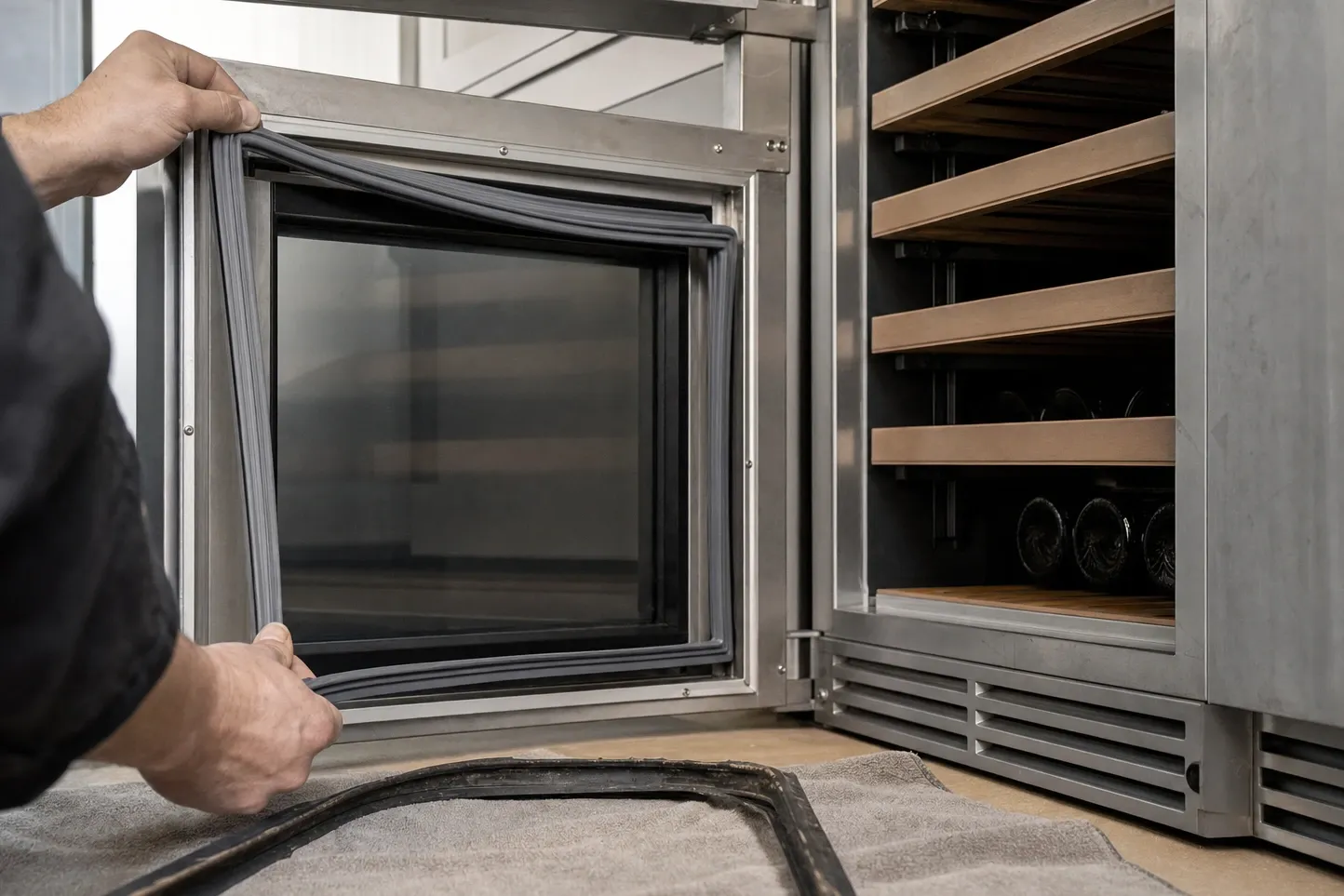
A seal doing its job is invisible, which is exactly the problem. It holds the door against the frame, keeps the kitchen out of a cold box, and lets the compressor stop; when it gives up it does not announce anything, it simply admits a little more warm air each month. Most households notice the consequences long before the moulding itself — a unit that runs and runs, frost gathering in one corner of the freezer, a door that wants a second push.
The paper test, at four points rather than one
The quickest check in the kitchen needs a supermarket receipt and no tools at all. Trap the paper between the shut door and the frame, then draw it out flat towards you, and pay attention to your fingers rather than to your eyes. Where the material is still soft the paper resists and then lets go in one small jump. Where it has hardened, the paper leaves without a sound.
One point proves nothing, because a seal rarely goes everywhere at once. Try the middle of the top edge, halfway down each side and near the middle of the bottom, then repeat the test a hand’s width in from each corner: corners are where the section has to fold in two directions, so they are usually first to let go. Each door on a two-door cabinet gets its own set of readings, and so does each of a pair of columns.
Note down every place the paper came out easily. That little map is the most useful thing an owner can hand over, because it separates material that has aged evenly from a door landing crooked.
What tired moulding feels like under a finger
Stand the door open and run a fingertip slowly along the face that meets the frame. New material gives under the pressure and pushes back at you. Aged material feels hard and faintly polished, and it holds the shape of your finger for a moment before recovering.
Look for a set as well — a flat, a dent or a shallow wave pressed into the section by years of resting against the same piece of metal. A set never irons out; it is the moulding remembering the door’s habit. Corners that look stretched, or a length standing proud of its channel at one end, belong to the same story. Heat accelerates all of it, which is why the same cabinet in a Tarzana kitchen that sits in the high nineties for months is generally further along than one in a shaded Windsor Square pantry.
Two more observations are worth collecting while you are there. If the magnet inside no longer tugs the door home over the last few millimetres, the strip has lost some of its pull. And if the door drifts back open from almost shut, the seal is being asked to hold something the hinge ought to be delivering.
Two things that look exactly like a worn seal
The first is a dirty one. Syrup, milk and the general film that settles on any kitchen surface make a seal grab in one spot and slip in the next, which reads as failure. Warm water and a soft cloth, worked round the whole perimeter and into the folds, is worth doing before condemning anything. If the paper drags everywhere afterwards, the material was never the fault.
The second is a door that has dropped. Hanging a fraction low at the handle end, it meets the frame corner first and never quite touches at the opposite corner. Paper finds that too, but the pattern differs: rather than loose points scattered round the door, you get one clean region of failure diagonally across from a region that is being crushed. That is a hinge conversation, and new material on a crooked door only buys a year of the same complaint.
What a replacement actually involves
The section comes off and goes back on with the door standing open and the cabinet exactly where the kitchen put it, so nothing is dragged into the room and no joinery has to be dismantled on a panel-ready front. The work is fiddly rather than heavy: the new length has to be seated square the whole way round and then proved with the door shut, because a fit that looks immaculate open can still leave a soft inch at one corner.
Before any of that, the door itself gets checked — how level it hangs, whether it still pulls itself closed from a hand’s width open, whether the frame it lands on is true. Those three answers decide whether fresh material will last. If you have done the paper test and the finger test already, say what you found when you ring Sub-Zero Repair Service Los Angeles on (310) 499-2240, and the visit picks up where you left off rather than starting again.
Follow-ups
- Does a hardened seal cost me anything while the food is still cold?
- Yes, quietly. The cabinet answers a leaking seal by running its compressor for longer, so the electricity bill moves before the temperature does, and on the freezer side the moisture riding in with that air collects as frost on whichever surface is coldest. Nothing breaks; everything simply works harder.
- Can I fit a new one myself?
- Nothing about the job is dangerous, so some owners do manage it. What decides the outcome is squareness rather than strength: seated a fraction out of true, fresh moulding leaves a soft patch that behaves exactly like the old one, and by that point the packaging has gone and the part will not be taken back.
- How often does a seal need changing?
- There is no schedule worth quoting, because two identical cabinets age at different rates depending on how warm the kitchen gets and how often the door is pulled. Judge the material in front of you instead: paper sliding free at several points, plus a face that feels hard, means it has finished its work.