How Are Integrated Column Hinges Different?
Written by
Elena Sandoval
Refrigeration technician — cabinet, door and seal work · 24 years in the trade
Checks seal geometry and door closure first on a warm-cabinet call. A unit fighting a poor seal all day makes the sealed system read badly, and the readings only mean anything once the door is closing the way it was built to.
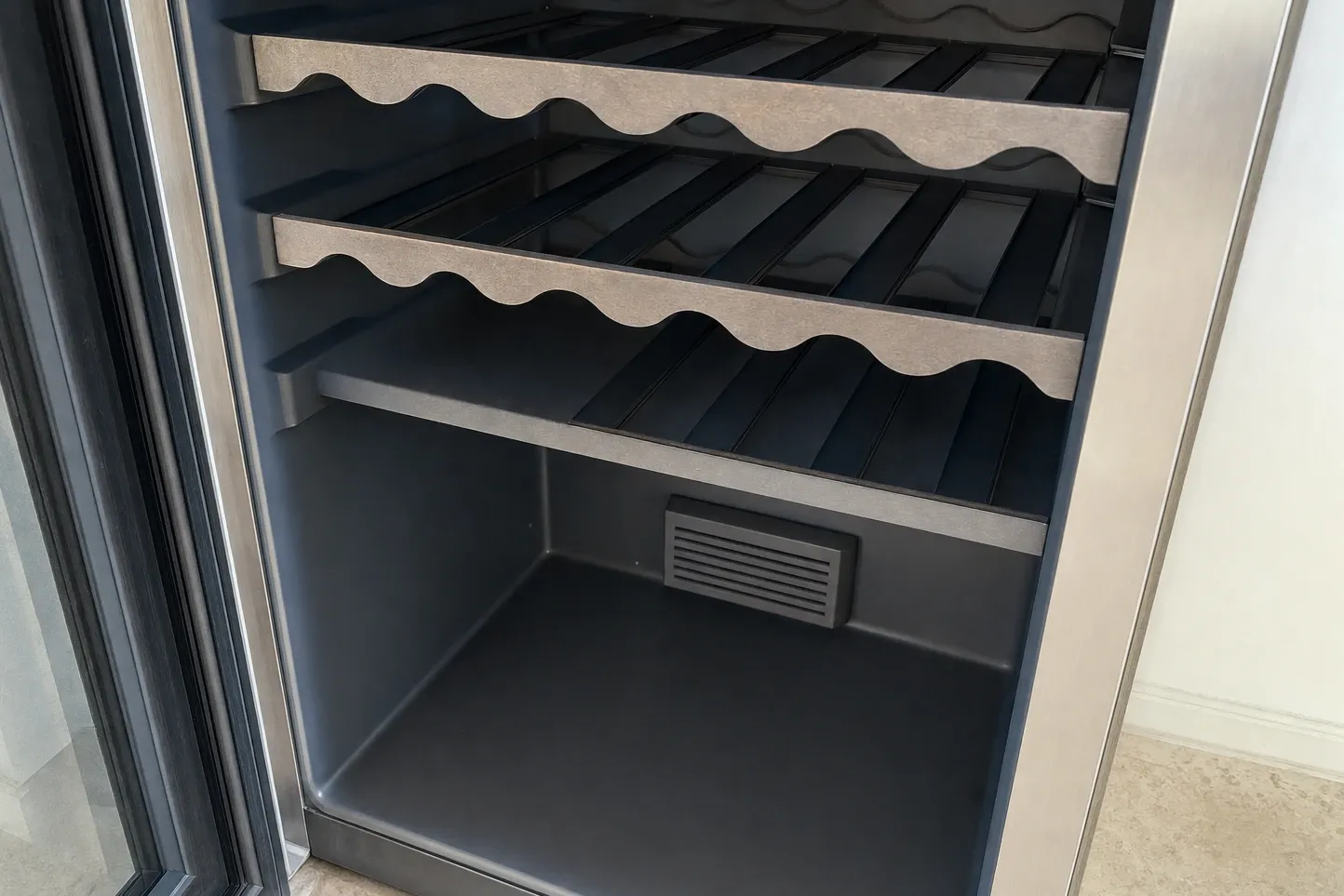
Ask what makes a column look like cabinetry and most people point at the panel. The panel is only half of it. A front hung on fittings that show at the edge always reads as an appliance, however good the timber, because the eye finds the hardware first. Sub-Zero’s answer on the Designer Series is to put the hinge out of sight: the manufacturer describes a hidden hinge creating a flush appearance in single or side-by-side installations, and that phrase is doing the real work in the design.
What “concealed” actually means here
The fitting lives inside the cabinet and behind the front, rather than bridging the two across the outside of the door. From the room you see two faces and the margin between them. There is no barrel, no visible plate, no screw head to catch the light along an eight-foot run of joinery.
That is the whole point. Everything a flush installation promises — the unbroken line of fronts, the appliance that disappears into the wall of cupboards — depends on there being nothing on the outside of the door to give it away.
What it changes for you: nothing to see, nothing to tweak
On a cabinet with visible hardware, an owner can at least look at the thing and tell whether a screw has backed out. On a column that option is gone. There is no inspection an owner can usefully perform, no cleaning that reaches it, and nothing to tighten by hand.
This is worth saying plainly, because the absence of anything to look at sends people to the wrong conclusions. A door that has begun to catch is not evidence of a broken fitting. It is evidence that something in the arrangement has moved, and the fitting is simply the only part that was ever holding the arrangement in place.
What it changes for the repair
Three things, in practice. Access comes first: reaching a concealed fitting means working the way the cabinet was designed to be worked on, which takes longer than reaching a plate on the face and is the main reason the job is not a five-minute call.
Order of work comes second. Whoever attends reads the margins and the behaviour of the door before touching a fixing, because a front that is out because the kitchen moved will not be put right by altering the appliance. And third, the panel usually stays where it is. Leaving your joinery hanging undisturbed is not politeness, it is the safest route to a door that ends up where it started.
The weight has not gone anywhere
Hiding the hardware does not lighten the front. A concealed fitting still carries every pound of the timber, the finish and the handle, several thousand openings a year, and it was set for the load that was on the door on the first day. Add to that load later and the geometry quietly loses. Most built-in doors close themselves because of the way the pivot is profiled, so the weight of the door brings it home over the final stretch; make the door heavier than that profile expects and the same weight starts working the other way.
The one thing an owner can usefully report
Watch the last two inches. Not the swing, not the noise — the final approach.
A door in good order slows as it comes in, meets all the way round together, and finishes the last fraction by itself. Report which of those three has stopped. A front that arrives at one corner ahead of the rest, a front that comes in level but will no longer draw itself shut from a hand-width open, and a front that hesitates part-way through the arc are three different faults with three different answers, and telling them apart is worth more than any amount of peering at hardware that was designed never to be seen.
Follow-ups
- Are concealed hinges weaker than the exposed kind?
- No, they are asked to do the same work out of sight. What changes is not strength but access: an exposed fitting can be looked at from the front of the kitchen, while a hidden one has to be reached the way the manufacturer intended, which is why guesswork from outside tends to go wrong.
- Can I adjust one with a hex key from a hardware shop?
- It is not an owner job, and the reason is the load rather than the tool. Anything holding a heavy panelled front is under tension while the front is still on it, and a fixing slackened in that state can travel further than intended and take the alignment with it.
- Does the panel have to come off for hinge work?
- Often not. A good deal is done with the front left exactly where it was hung, which is the outcome worth aiming for, because joinery that never moves cannot come back a shade out of line. Whether it is possible depends on what has to be reached.
- What should I have ready when I book?
- How the door behaves in its final stretch of travel, whether it still returns on its own, and where on the edge any mark sits. Tell that to Sub-Zero Repair Service Los Angeles on (310) 499-2240 and the $89 visit spends its time on the fix rather than on the interview.