Two Columns Side by Side: Why Does the Gap Between Them Matter?
Written by
Elena Sandoval
Refrigeration technician — cabinet, door and seal work · 24 years in the trade
Checks seal geometry and door closure first on a warm-cabinet call. A unit fighting a poor seal all day makes the sealed system read badly, and the readings only mean anything once the door is closing the way it was built to.
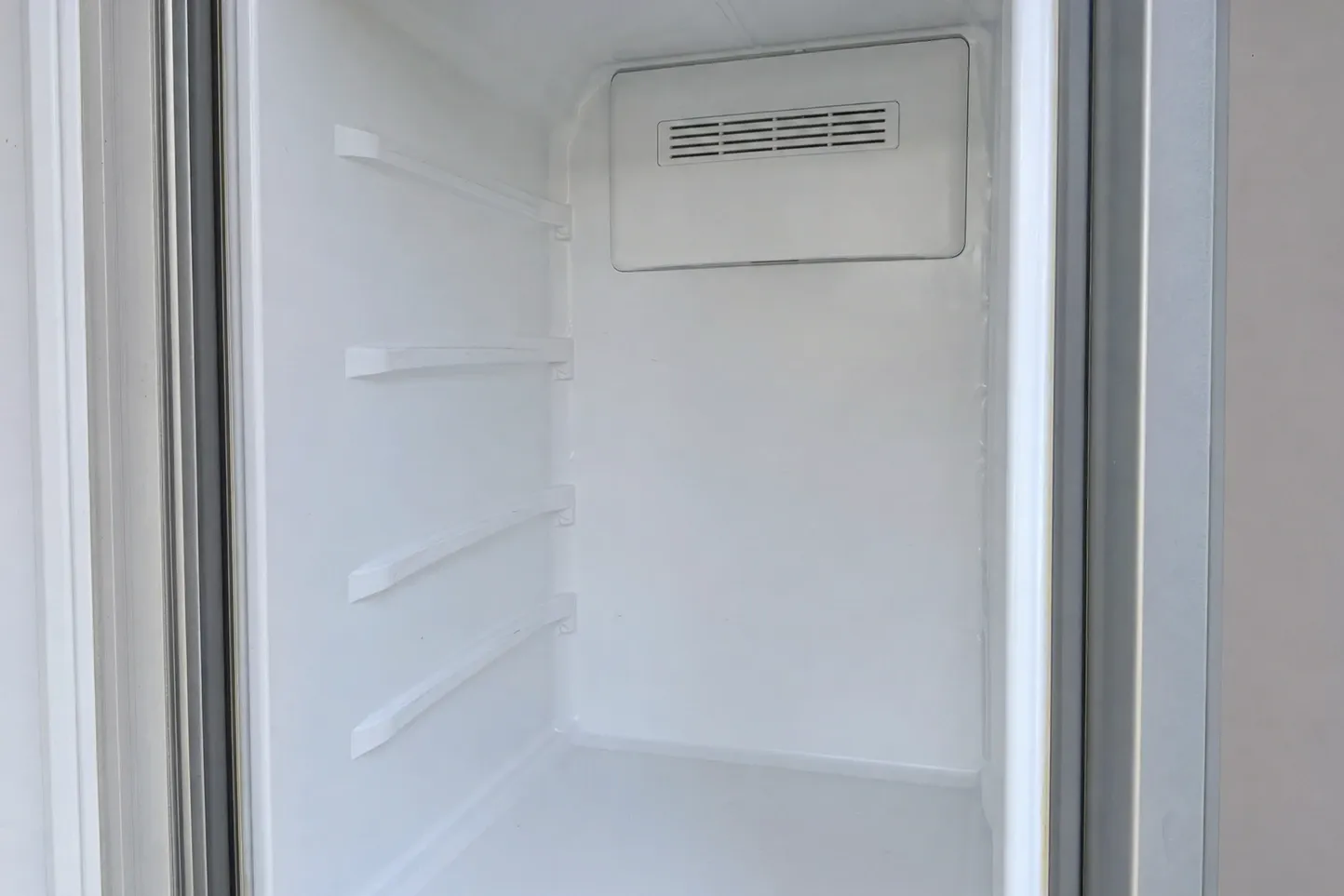
A refrigerator column beside a freezer column reads as one tall appliance. It is not. It is two independent cabinets, bought as a pair, set into one run of joinery and asked to look like a single object — and Sub-Zero designs for exactly that, describing a hidden hinge that gives a flush appearance in single or multiple side-by-side installations. Every complaint on this page comes out of the difference between what the pair looks like and what it is.
Two cabinets, one run of joinery
Each column stands on its own, carries its own front, and has its own fixings holding that front where the installer left it. They are neighbours, not partners. Nothing mechanical connects the alignment of one to the alignment of the other.
Your eye disagrees. It treats the two fronts as one surface, and a surface with a step in it is the first thing anyone notices walking into a kitchen. So the pair is held to a standard neither cabinet is aware of.
The line between the fronts is the tell-tale
The vertical line where the two fronts meet is the most sensitive instrument in the room. Down its whole height it is either parallel or it is not, and a front that has moved shows up as a wedge: tight at the top and open at the bottom, or the reverse.
This is why the line matters more than any single margin. A front that has settled at the handle end opens the line at the top and nowhere else. A cabinet standing on a floor that has lifted at one end tilts the whole line. A front that has grown across its width narrows the line evenly from top to bottom. Three different movements, three different signatures, all legible without a tool — provided you look at the line itself rather than at the two doors either side of it.
Doors that open towards each other
Most pairs are hung so the two doors open outwards from the middle. The handles then live close together, and their arcs begin within an inch or two of each other.
That arrangement is fine while everything is where it was put. It stops being fine when one front gains thickness or a handle is changed, because the clearance between two moving objects is the first thing to be spent. The usual report is a brush or a tick as one door passes the other’s handle, and the usual conclusion — that the gap between the cabinets is wrong — is the wrong one. The gap has not changed. The swing has.
Levelled to the run, not to each other
An installer sets each cabinet to the joinery and the floor, because the joinery is what the whole kitchen is squared to. Neither column is levelled against its neighbour.
That sounds like a weakness and is in fact the only sane approach: two cabinets levelled to each other and both out of true with the room would give you a matched pair sitting crooked in a straight line of cupboards. It does mean, though, that when one cabinet moves the pair stops agreeing, and the disagreement is visible long before either one is far enough out to cause a fault on its own.
Reading a pair before deciding which one moved
Stand a few paces back, square to the fronts, at eye height. Follow the line between them from top to bottom and note which end is open. Then check each front against the cabinetry on its outer side, where the run gives you a fixed reference the two doors cannot supply for each other.
That second reading settles it. If the left-hand front is parallel with the cupboards to its left, the left-hand cabinet is fine and the right-hand one has moved. Do that before anyone adjusts anything, because the cabinet that appears to be out is, more often than people expect, the one still sitting where it was installed.
Follow-ups
- The two fronts are different widths. Is that a mistake?
- Almost never. Pairs are specified to suit the household rather than to match, so a wider refrigerator beside a narrower freezer is a common choice, and the joinery is drawn around whatever pair was bought. What should match is the line between them, top to bottom, not the widths either side of it.
- One door now brushes the other handle as it swings. What changed?
- Something in the arc, not in the space. A handle swapped for a deeper one, a front refinished a shade thicker, or a door that has settled and now travels along a slightly different path. The two were clearing each other by a small margin before, and small is all it takes.
- Should I ask for both cabinets to be looked at, or just the one that moved?
- Both get read, even when only one is at fault, because the line between them is a comparison and a comparison needs two readings. It costs nothing extra to look at the partner, and it prevents the classic outcome of adjusting a cabinet that was sitting exactly where it should be.
- What is useful to have ready before the visit?
- A photograph taken square to the pair from a few paces back, plus a note of anything done to the kitchen recently — flooring, worktops, refinished fronts. Give that to Sub-Zero Repair Service Los Angeles on (310) 499-2240 and the $89 diagnostic visit starts halfway through the reasoning.