Valley Heat, City Water 5 of 5
Sub-Zero Ice Cubes Not Floating: What It Means
Written by
Elena Sandoval
Refrigeration technician — cabinet, door and seal work · 24 years in the trade
Checks seal geometry and door closure first on a warm-cabinet call. A unit fighting a poor seal all day makes the sealed system read badly, and the readings only mean anything once the door is closing the way it was built to.
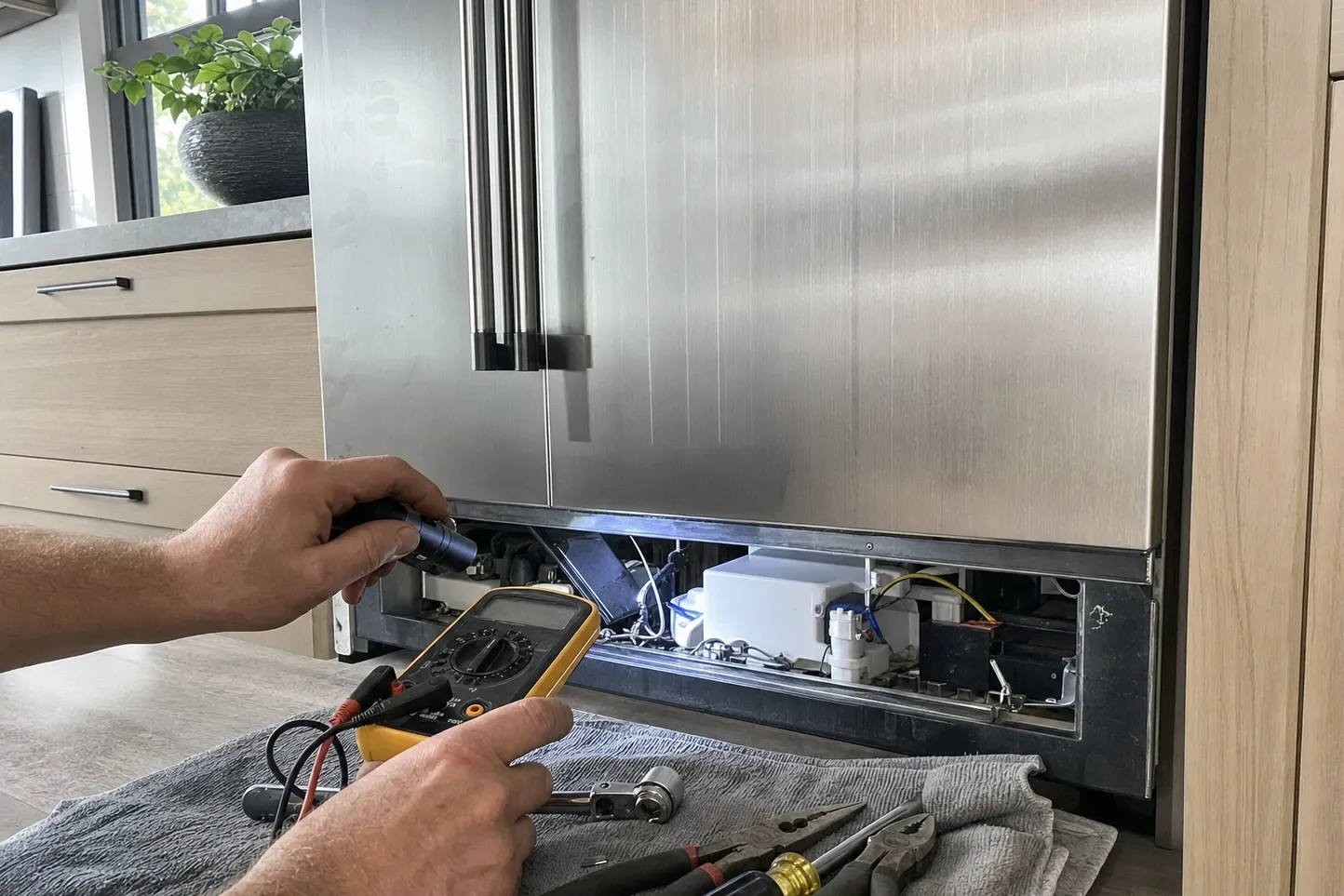
Ice made from plain water floats almost every time, so a cube resting on the bottom of a glass is telling you about the glass, not the freezer. Either the liquid around it is lighter than ice, which is true of high-proof spirits and many strong cocktails, or the cube is physically held down: wedged under its neighbors in a packed tumbler, or stuck to a glass that came out of the freezer drawer. Nothing a refrigerator does can make frozen tap water heavier than the water it came from. What a Sub-Zero ice maker can change is the size, clarity and shape of each cube, and those details are worth reading, because they point to pressure, filtration and fill problems long before the bin runs dry.
Why ice floats at all
Water is an odd liquid. Most substances shrink as they solidify, but water molecules lock into an open, six-sided lattice when they freeze, and that lattice takes up roughly nine percent more room than the liquid did. The same weight spread over more space makes ice lighter for its size, so a cube rides with about nine-tenths of itself below the surface and a sliver above it, the same proportion that lets an iceberg drift instead of settling on the seabed. Dissolved minerals from the tap barely shift that balance; hard water still freezes into ice that floats. That is why a sinking cube is not a sign of contaminated water or a faulty appliance. For it to drop, the liquid around it has to be lighter than ice, or something has to be pressing on it.
The usual reasons a cube ends up on the bottom
Alcohol is the big one. Ethanol is much lighter than water, so the stronger the pour, the less lift a cube gets; in a neat high-proof spirit, ice can drift down to the floor of the glass, while the same cube bobs happily in a highball once the mixer goes in. A tumbler crammed to the rim is the second explanation: the lowest cubes cannot rise because the ones stacked above them are resting on top. The third is a cube frozen fast to a glass that was chilled in the freezer, which usually lets go within a minute or so as the glass warms. None of these involves the appliance, and you can rule all three out by dropping a single cube into a glass of ordinary tap water.
How a Sub-Zero ice maker builds each cube
The ice maker inside a built-in Sub-Zero freezer runs in a loop. A water valve opens for a few seconds and meters water into a molded tray. Cold freezer air chills the tray until a sensor reads it as frozen solid, a small heater warms the cups just enough to free the ice, and an ejector sweeps the cubes into the bin. The pace is unhurried: each harvest tips roughly 8 cubes, around 4.6 oz of ice, into the bin, and the next follows 2 to 3 hours later, so a whole day yields somewhere from 64 to 96 cubes. When the pile is high enough the module rests, and from a bare bin it can be 2 days before things look full. Each cube is still just frozen water, so each one should float.
Clear, cloudy and hollow cubes
Freezing in that tray starts at the walls and creeps inward, pushing dissolved air and minerals ahead of the ice front. Whatever cannot escape is trapped in the last part to freeze, which is the white, cloudy core you see in most home ice. Cloudy cubes actually float a touch higher than clear ones, because trapped air makes them lighter, so cloudiness has nothing to do with sinking. It does say something about the water. Los Angeles tap water is hard enough that white scale on taps and kettles is familiar in most kitchens, and the same minerals slowly coat the fill tube and tray. How that differs between Tarzana and Windsor Square is covered in our piece on why ice makers scale faster in the Valley.
The undercounter UC-15I makes ice another way
The undercounter UC-15I does not fill a tray and wait. Clear-ice machines of this kind generally run water across a chilled plate, freezing it in thin layers so air and minerals rinse off. Its ceiling is 50 lb of ice in a day and its bin holds as much as 25 lb, yet it drinks close to 1 gallon each hour, some 24 gallons from midnight to midnight; that surplus flushes impurities away. If one hums along making nothing, check supply pressure first, where Sub-Zero’s floor is 20 psi (1.4 bar) and its ceiling 80 psi (5.5 bar), then the surrounding air: 50°F to 100°F for an indoor install, 50°F to 110°F outside. A Tarzana patio unit can edge toward that outdoor limit in a heat wave, the strain covered in our guide to hundred-degree Valley afternoons.
Cube shapes that do point to a fault
Sinking ice is a question about the drink; small, thin or hollow ice is a question about the machine. Undersized cubes usually mean the tray is not getting its full measure of water. The supply may simply be weak. Some Sub-Zero models are content anywhere from 20-100 psi while others insist on 35-120 psi, and no gauge comes in the box, so have a plumber take the reading. A clogged cartridge, a kinked or partly frozen line, or a valve that sticks will starve the tray just the same. Reverse osmosis is workable too, as long as the line pressure stays steady inside 35-120 psi. A model with its own push-in or twist-in cartridge has that cartridge bypassed, and copper has no place in the line after the RO system.
Reading the display before anyone visits
On Classic, Designer and IW-30CI units, a single ice cube icon shows the ice maker is switched on, and three cubes mean Max Ice is running to boost production ahead of a gathering. No icon means the ice maker is off, and that is worth ruling out before blaming any part. On a 600 Series or 700 Series, EC 30 with Service flashing means the ice maker shut itself down after the water valve was called on too many times. Sub-Zero’s advice is to turn the ice maker off, then pass the code and the displayed temperatures on to whoever services it. Note them down, along with roughly how many harvests you hear in a day and whether the water line was disturbed during a recent remodel.
When it is worth a visit
If your cubes float happily in tap water but keep arriving small, hollow, slow or not at all, the trouble sits in the valve, the supply, the tray or its controls, and that is diagnosable work. We handle Sub-Zero ice maker repair in homes from Toluca Lake and Tarzana to Beverly Grove and Windsor Square. Ring (310) 499-2240 or use the booking button on this page. The visit costs $89 for the drive out and the detective work of tracing the fault, and that same sum is knocked off the repair invoice once you tell us to go ahead.
Follow-ups
- Does ice sinking in my drink mean the ice maker is broken?
- No, sinking ice almost never points to the appliance. Ice frozen from tap water is lighter than water, so it floats in a plain glass every time; it sinks only when the drink is lighter than ice, as strong liquor is, or when other cubes hold it down. Drop one cube into tap water to settle the question.
- Why does ice ride lower in some drinks than in others?
- Ice rides lower as the drink gets lighter, and alcohol is the usual reason. Water gives a cube plenty of lift, a mixed drink gives a little less, and a neat high-proof spirit may give too little to hold it up at all. Sodas and juices carry sugar, which makes them denser, so cubes sit slightly higher in them.
- Why is the bin still half empty a day after I switched the ice maker on?
- Because a bare bin can need up to 2 days to fill. Over twenty-four hours the freezer's ice maker manages only 64 to 96 cubes, delivered in drops of about 8 spaced 2 to 3 hours apart, and it idles whenever the bin is topped up, so a sluggish refill after a power cut or a party is expected.
- Can I restart a Sub-Zero ice maker myself before calling anyone?
- Yes: switching the ice maker off and back on at the control is the closest thing to a reset an owner has. On Classic, Designer and IW-30CI units, one ice cube icon confirms it is running. If a 600 Series or 700 Series shows EC 30 with Service flashing, leave the ice maker off and book a visit instead of cycling it.